When choosing a suit, most men focus on color first.
Then perhaps the pattern, the construction or the brand.
But one of the decisions that has a surprisingly large effect on how a suit feels and wears is something most people rarely think about: fabric weight.
A fabric’s weight influences how it feels against the body, how it handles temperature, how it drapes and how appropriate it is for different seasons and settings.
But weight doesn’t tell the entire story.
Two fabrics with similar weights can behave very differently depending on their weave, fiber and construction.
Understanding these differences makes choosing a suit fabric much easier.
What Does Suit Fabric Weight Mean?
Fabric weight refers to how heavy a particular fabric is.
For suiting, this is commonly expressed as grams per square meter (GSM).
The higher the GSM, the more material there is within a given area of fabric.
But heavier does not automatically mean better.
And lighter does not automatically mean more comfortable.
A lightweight fabric may feel excellent in warm weather but lack some of the structure or drape you want from a formal suit.
A heavier fabric may provide beautiful drape and structure but feel excessive in a warmer climate.
The right weight depends on how, where and when you intend to wear the suit.
Why Fabric Weight Matters
Fabric weight influences several characteristics of a suit.
Comfort
Lighter fabrics can feel easier to wear in warmer conditions.
Heavier fabrics can provide more warmth and substance in cooler environments.
Drape
Weight can contribute to the way fabric falls from the body.
A fabric with sufficient substance can create a clean, controlled drape rather than appearing overly flimsy.
Structure
Heavier fabrics can often hold their shape well, while lighter fabrics may produce a softer silhouette.
Neither is inherently better.
It depends on the look you’re trying to achieve.
Durability
Fabric weight can contribute to longevity, but weight alone does not determine durability.
Fiber quality, weave, finishing and how the garment is worn all matter.
This is why choosing a suit based solely on GSM can be misleading.
What Is GSM in Suit Fabric?
GSM stands for grams per square meter.
It provides a standardized way of describing fabric weight.
In simple terms, if one fabric has a higher GSM than another, it contains more fabric mass per square meter.
But GSM should be treated as a useful reference point rather than a complete measure of quality.
A 280 GSM fabric isn’t automatically better than a 240 GSM fabric.
The more useful question is:
What does that weight achieve in this particular fabric?
A fabric’s weave, fiber, finish and intended use all influence how it performs.
Lightweight, Midweight and Heavyweight Fabrics
There isn’t one universal classification that every mill uses, but suit fabrics can broadly be thought of in three groups.
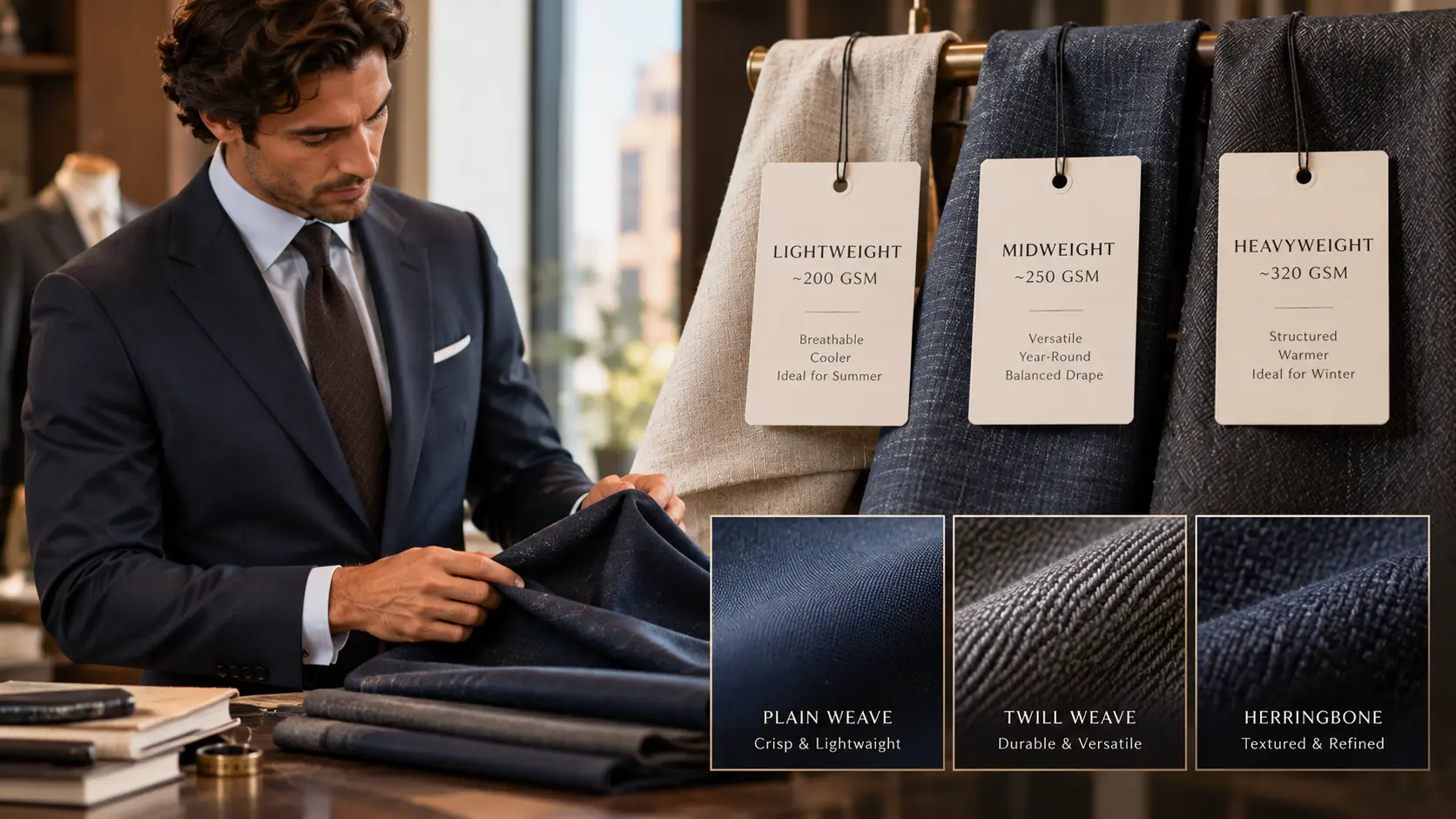
Lightweight Fabrics
Lightweight fabrics are generally associated with warmer climates and summer dressing.
They can feel breathable and easy to wear, particularly when temperatures rise.
They can work well for:
• Summer suits
• Travel
• Daytime events
• Warm climates
• Less structured tailoring
The trade-off is that very lightweight fabrics may not have the same substance or drape as heavier alternatives.
Midweight Fabrics
For many wardrobes, midweight fabrics offer the greatest versatility.
They can work across a broader range of temperatures and occasions while maintaining enough structure for refined tailoring.
This makes them particularly useful for a suit that is expected to be worn regularly rather than only during a specific season.
For an executive wardrobe, versatility can often be more valuable than optimizing every suit for one particular temperature.
Heavyweight Fabrics
Heavier fabrics are generally better suited to cooler conditions.
They can provide warmth, structure and a more substantial drape.
They may work particularly well for:
• Autumn and winter
• Cooler climates
• Formal tailoring
• Structured silhouettes
• Textured fabrics
But heavier doesn’t mean more luxurious. It simply means the fabric has more substance.
Weight Isn't the Same as Warmth
This is an important distinction.
Fabric weight and perceived warmth are related, but they aren’t identical.
A fabric’s weave influences how much air can move through it.
Its fiber composition and finishing also affect how it feels against the body.
This means a lighter fabric with a particular weave may perform differently from another fabric of similar weight.
When choosing a suit for a warm climate, therefore, don’t simply ask: “How many GSM is it?”
Ask: “How does this fabric breathe and behave?”
How Weave Changes the Way Fabric Performs
The weave determines how the yarns are arranged within the fabric.
This can influence texture, breathability, appearance and durability.
Some common weaves you’ll encounter in suiting include:
Plain Weave
A straightforward structure that can produce a clean, crisp appearance.
Twill
Recognizable by its diagonal structure, twill fabrics can offer a smooth appearance and good drape.
Hopsack
An open weave that can allow greater airflow and produce a distinctive texture. It can be particularly useful in warmer-weather tailoring.
Birdseye
A small repeating texture that adds visual interest while remaining relatively understated. The weave is one reason two fabrics with similar weights can feel completely different.
Weight gives you one piece of information. Weave tells you more about how the fabric behaves.
What Does Fabric Drape Mean?
Drape describes how a fabric falls and hangs when it is worn.
It is one of those tailoring terms that sounds technical but is relatively simple to understand.
A fabric with good drape tends to fall cleanly around the body rather than standing away from it or collapsing awkwardly.
Weight can influence drape.
But so can:
• Fiber
• Yarn
• Weave
• Finishing
• Fabric construction
This is why simply choosing the heaviest fabric available isn’t necessarily the way to achieve better drape.
The fabric needs to work with the intended silhouette.
How Should You Choose Fabric Weight for Your Climate?
Climate should be one of the first considerations.
If you live somewhere consistently warm, an extremely heavy fabric may spend most of its life hanging in your wardrobe.
A lighter or breathable fabric may be far more useful.
If you live somewhere with distinct seasons, a wardrobe can be divided across different weights.
For someone who travels frequently, the calculation becomes more complicated.
A travel suit may need to balance:
• Comfort
• Wrinkle resistance
• Breathability
• Durability
• Versatility
This is one reason fabric selection is ultimately personal. There isn’t one perfect suit weight for everyone.
Should Your Suit Fabric Weight Change by Occasion?
It can.
A suit for daily business wear may need to prioritize versatility and durability.
A summer wedding suit may benefit from lighter construction and greater breathability.
An autumn evening suit can take advantage of more substantial fabrics and richer textures.
A formal winter suit may benefit from additional weight and structure.
The fabric should support the purpose of the garment. That is more useful than following a rigid seasonal rule.
Does Heavier Fabric Mean a Better Suit?
No.
This is one of the easiest assumptions to make—and one of the least useful.
Fabric quality isn’t determined by weight alone.
A lighter premium fabric can be more appropriate, more comfortable and more sophisticated than a heavy fabric that isn’t suited to the wearer or occasion.
Think of fabric weight as one variable in a much larger equation.
Fiber quality. Weave. Finishing. Drape. Construction. Climate. Wear frequency.
All of these matter.
How Should You Choose the Right Fabric?
Instead of asking for the “best” fabric weight, start with five questions:
Where will I wear the suit? Climate matters.
When will I wear it? Season and time of day influence the choice.
How often will I wear it? A frequently worn suit may benefit from versatility and durability.
How do I want it to drape? The desired silhouette influences fabric selection.
What does the fabric feel like? Technical specifications are useful, but they don’t replace actually evaluating the cloth.
A good fabric choice is one that works on paper and on the person wearing it.
Fabric Selection Is Part of the Tailoring Process
The right suit fabric isn’t simply the one with the most impressive specification.
It is the fabric that supports the garment’s purpose.
A lightweight open weave may make sense for a warm-weather suit.
A more substantial wool may be better for cooler conditions.
A midweight cloth may be the smartest choice for someone who wants one highly versatile suit.
And sometimes the most important consideration is not the season at all, but how the wearer wants the suit to look and feel.
That is where fabric expertise becomes valuable.
Because choosing cloth isn’t simply about numbers.
It is about understanding how those numbers translate into comfort, movement, drape and appearance.
The Right Fabric Should Work With You
A well-chosen suit fabric should feel appropriate before you even begin thinking about the details.
It should suit your climate.
It should suit the occasion.
It should support the silhouette.
And it should feel comfortable enough that you actually want to wear the suit.
Fabric weight is an important part of that decision.
But it is only part of it.
The best choice comes from looking at the entire picture—weight, weave, fiber, drape, construction and the person wearing it.
When you’re ready to choose a cloth around your lifestyle, climate and wardrobe needs, a private consultation can help identify the right direction.
Frequently Asked Questions
1. What is a good weight for suit fabric?
There is no single ideal weight. Lightweight fabrics can work well in warmer climates, while midweight fabrics offer versatility and heavier fabrics are generally better suited to cooler conditions. The right choice depends on climate, occasion and intended use.
2. What does GSM mean in suit fabric?
GSM stands for grams per square meter and is a measurement of fabric weight. It is useful when comparing fabrics, but it should not be used as the sole measure of quality or performance.
3. Is heavier suit fabric better?
Not necessarily. Heavier fabric can provide warmth, structure and substance, but a lighter fabric may be more appropriate for a warm climate or a particular style of suit. Fabric quality depends on several factors beyond weight.
4. Does fabric weight affect suit drape?
Yes, fabric weight can influence drape, but it is not the only factor. Fiber, yarn, weave and finishing also affect how a fabric falls and behaves on the body.
5. What suit fabric weight is best for hot weather?
Lighter, breathable fabrics are generally more suitable for hot weather. However, weave is also important because an open or breathable weave can perform differently from a more tightly constructed fabric of a similar weight.
6. Should I choose different suit weights for different seasons?
If you regularly experience seasonal changes, having fabrics suited to different conditions can make your wardrobe more comfortable and versatile. If you live in a consistently warm climate, prioritizing breathable and adaptable fabrics may be more useful than maintaining a wide range of weights.